
Looking Outward and Inward
Interview with Critical Mass 2025 Top 50 Photographer Argus Paul Estabrook
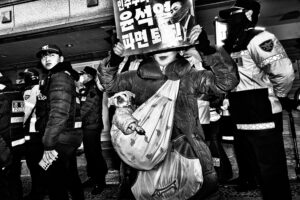
For photographer Argus Paul Estabrook, every image is a kind of self-portrait. Moving amidst the bustling city of Seoul, he uses street photography to explore his Korean-American identity through images of others. In his 2024 Where Do We series, he documents protests against President Yoon Suk Yeol through dynamic black and white night scenes that demonstrate his unique technical use of exposure, shutter speed, and flash to capture both stillness and movement. His photographs from the series were selected as part of the 2025 Critical Mass Top 50, and his submission portfolio can be viewed here.
In this interview with Sofia Rivera, Estabrook speaks about his photographic influences, how his Korean-American identity informs his work, and his first book, Half Eye.

Sofia Rivera: What inspired you to become a photographer? Can you talk a bit about how you came to the field?
Argus Paul Estabrook: It’s a bit of a long story. Photography seems to have always been with me. My father gave me an OM-1, and the next thing I knew, I was off into the world studying it. Growing up, I wanted to be a writer and an artist, but for some reason, the camera just clicked. Bad pun. Ok. Moving on, and move I did, eventually coming to Korea in 2010. It wasn’t until then that I grew comfortable using photography to explore my thoughts about life. Around that time, I came to see myself as a “half eye” due to my biracial, Korean-American background, and began using the viewfinder to look both outward and inward. In that way, I think all my images are partially self-portraits. But when I make them, I’m in a world I often feel removed from. So I endeavor to take photos from a space of honesty and return them as a possible dialogue where the immediacy of words fails. Photography then becomes a practice of empathy.
SR: Your projects often focus on urban characters, sometimes reminiscent of Weegee, Brassaï, Fink, and Arbus, but your style is distinctively defined by movement—flashing lights and blurred surroundings, each snapshot vibrating with life. Who are some of your visual influences?
AE: It’s a very kind compliment to hear those names, thank you. I definitely studied their work. For influences, it’s difficult to say succinctly because I feel the list has become a bit of a stew. I was incredibly fortunate to have educators who turned me on to so many different modes of visual storytelling. I feel even more lucky that I went to university with other passionate photo students, one of whom was Preston Gannaway. I know I learned a lot from her and all our friends during that time. It’s funny because at our school, they really impressed upon us the importance of color formalism. My black and white imagery was a way to break those rules. However, these days, I’m feeling a pull back to color. Erwitt said something like color is descriptive and black and white is interpretive. I reflect on that a lot, wondering if I can use color to lean into interpretation more. But if I’m being honest, as a failed musician, I tend to use the camera to photograph sounds. When I feel encouraged to shoot or author a series, I’m always thinking: what does this overall experience sound like internally?

SR: Your projects often center identity, race, and politics. How do you use photography as a tool for reflecting society?
AE: I consider myself a Korean-American Gyopo living in my birth country, trying to catch up on lessons that weren’t available to me while being raised in the USA. Photography lets me tap into that space of pre-language, moving toward a shared experience. That’s been very helpful since I struggle with speaking Korean. The camera allows me to communicate ideas about identity, race, and politics by mirroring my surroundings and thoughts. It also becomes a form of self-education because sometimes I’m confused by what I encounter and ask others to help me understand cultural nuances that might have escaped me at the time of capture.
SR: In your 2025 Critical Mass portfolio, you selected work from your series Where Do We, which centers political tensions in Seoul amidst former South Korean President Yoon Suk’s imposition of martial law in December 2024. You talk about trying to capture time sped up and slowed down in this series. How does temporality play a role in your practice more broadly?
AE: I think deeply about the concept of time. To me, how we register it in one environment or another often seems to be based on emotional perception. It’s quite fascinating. During those protest events, time seemed to fly by when the momentum of the moment was “on the people’s side.” In contrast, when things were seemingly bleak, and that energy hit a wall, the hours felt a bit stuck. Things like despair and grief are processed differently than joy, and that’s connected to how we experience the passage of it. This seems to be because time is weighted in the gravity of possibility. How we fall into it at different stages of our lives affects how we decide what comes next. Photography, to me, is not the action of drawing with light as much as it is the practice of aligning ourselves to the speed of an experience. That’s why a photograph stays in memory. Memory is the speed of understanding.
SR: Your work was recently shown as part of Dublin’s Street Photography Festival. What is it like seeing your images of Seoul be publicly displayed in a new city, in a new context?
AE: Oh, it’s always nice to see photos of Seoul get out there in the world that haven’t been groomed by Korea’s tourism department. Of course, my vision of the country is simply my own. I often struggle with the feeling that I’m not “Korean enough” to speak on what I see here, but I remind myself that my personal code of ethics and honor supersede those insecurities. What is Korea? I learn by polishing stones to skip on the river of life. The ripples mean more than anything permanent.

SR: Your photobook Half Eye was published with Eyeshot in 2023. Can you talk about the process of creation and collaboration that went into this book?
AE: I didn’t want to do it initially. When they first reached out, I pushed it off because I’ve always felt my work was more like short stories and couldn’t visualize a book. A lot of my mentors and friends encouraged me to reconsider. Eyeshot approached me again, and by that time, I was able to see it as an opportunity to share a chapter of my photographic journey. It was difficult for me because the work felt so personal. Ultimately, I shared my vision with Eyeshot, they came back with a few edits, and we arrived at an agreement that felt authentic. I’m truly proud of the book we made.
SR: You recently started a Substack. What will your focus be? What is your relationship to writing and how does it play a role in your projects?
AE: Substack seems promising. I don’t have much to say here. I just hate Zuckhead. Every time I’m on Instagram, I feel like I’m Clockwork Oranging myself. Beethoven just wrote music, right? Anyway, I’m trying to find another way to communicate my work. With the release of Half Eye, I feel I can finally put black and white photography down for a while. I’m hoping the platform will become a space where I can articulate my thoughts more clearly and share new projects. I’m very new to it, so feel free to subscribe!
SR: In addition to being selected for Critical Mass Top 50 four times, you have received awards from American Photography, Magnum Photos, and LensCulture, among others. What professional advice do you have for early photographers navigating the art world?
AE: I don’t have much advice, as I don’t think I’m successful in terms of financial stability or some idealized renown. I guess I would say find a day job that you love, one that you can draw from and integrate into your own practice. Most people in Korea know me as an English teacher, and I usually keep my photography a secret from those outside our community. I’d be more inclined to share what I do, but street photography seems to have become more suspicious these days to the general public.
Recently, though, I’ve experienced a strange phenomenon in Korea where other photographers will recognize me on the street or in places like museums. Not going to lie, it’s kinda cool, but nerve-racking too. I always try to impress upon new friends that street photography specifically needs more sensitivity and that we must resist the impulse to intrude on another’s space. It’s a hard concept for us because we don’t want to lose a potential shot. I try to explain it like this: is what you see a person, or the context of a person? What’s important is how we recontextualize things, and that is a personal matter. I feel that’s the core of authorship, or simply, just our heart mirrored in the world.
SR: In an image-saturated world, it can be difficult to make your photographs stand out. How do you navigate this challenge, and how has the current media landscape affected your practice?
AE: Fortunately and unfortunately, the inherent quality of our medium is suited to mass production and instant deliverability. When I first started out, I thought I could use my identity as a Gyopo as a bridge between my two cultures. Now I realize that’s a folly. I just make work for myself and skip my stones on the river. Of course, having the images out there is important, but it’s not as important as being honest about why we create them and following through with intention. The current landscape seems to reward simply following the surface our stones skip on, and not the wishes we made when we decided to take aim.
SR: What are you currently working on, and what projects are on the horizon for you?
AE: I’ve noticed in some of my recent photographs that the people portrayed seem to be constrained by their environments. In other images, the opposite appears true. I’ve been thinking a lot about what that means to me and how I am relating to those visual cues at this point in my life. Some pals of mine are encouraging me to start a YouTube channel, but who knows. Regardless, I can feel the seeds for a new book, and I’m grateful for that.
Argus Paul Estabrook is a Korean-American photographer based in Seoul who uses street photography to explore personal and cultural narratives. He was part of Photolucida Critical Mass Top 50 in 2025, and his submission can be viewed here.
Sofia Rivera is a 2026 Critical Mass Intern pursuing an Art History MA from Hunter College, CUNY. She has held research and curatorial positions at the Whitney Museum of American Art, the Columbia Journalism School, and the National Endowment for the Humanities.


