
Constructing a Counter-Archive
Interview with Critical Mass 2025 Top 50 Photographer Britt Bradley
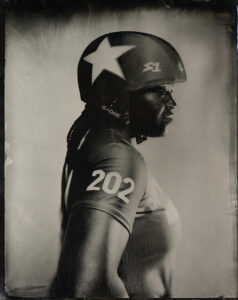
Largely informed by her professional background in photographic collections management, Britt Bradley (AKA Nitrate Fox) uses alternative photographic processes to highlight historically marginalized female and queer figures. For Bradley, wet-plate photography is not just an object of historical fascination, it’s also an empowering tool she uses to uplift her roller derby community through portraiture. Her photo series Jamnesia was selected as part of the Critical Mass Top 50 in 2025, and Bradley also self-published a book of the series last year (available for purchase here). Her 2025 Critical Mass Top 50 submission portfolio can be viewed here.
In this interview with Sofia Rivera, Bradley discusses the importance of community in photographic practice, navigating the field as a queer woman, and achieving her career goal of being selected for the 2025 Critical Mass Top 50.
Sofia Rivera: How did you come to photography? Were you always interested in it, or did you experiment with other art forms first?
Britt Bradley: I actually started in photography pretty young. My dad was a hobbyist, and so I developed my first roll of film when I was about eight or nine, and I can still vividly remember developing that first roll in a closet in our house while my dad shouted directions at me through the door. Both my parents were very photographically inclined communicators, so it’s kind of always been there, but I developed more appreciation for the visual language early in college.
SR: I’m curious about your creative process when it comes to using wet-plate to photograph your roller derby community. How do you navigate these elements of history and modernity?
BB: In addition to my background in art and being an artist myself, I’m also a collection specialist for an archive. I’ve worked in several museums with large archives of artists’ work like Dorothea Lange and Anne Brigman, so, I’m personally very interested in the idea of the artist’s archive and how an artist can approach their specific moment in history. My interest in early photo history overlaps heavily with who I choose to photograph. I find when you look back at images that were made using wet-plate initially, there’s a certain exclusivity with who gets photographed and why, and so I love the idea of using a medium that was initially used to other or to further these narratives of wealth and privilege to instead tell stories of people that we know existed during the time that the photographic medium was first being used but were perhaps excluded from that narrative.
SR: Can you speak more about how you’re approaching building your archive?
BB: I think it’s hard if you’re an artist who is in any way tapped into the history of your medium, whatever that medium is, to ignore, at least for a photographer like myself, that every major advance in photographic technology has been made to render white skin. Those conversations about who was photographed and why and how factor a lot into the interactions that I have with my sitters now. We have a lot of dialogue and conversations about why you might look a certain way and how we can manipulate that, or use that to our advantage when we’re collaborating on a portrait or a specific instance. I think choosing to ignore that narrative, that piece of history, and how exclusive it was, would be irresponsible. But it also allows me to have really great conversations and interactions on a more collaborative level with whoever it is I’m photographing.

SR: Your work is inspired by and rooted in community, especially femme and queer spaces. How do you share your interest in wet-plate photographs with others? Is education in alternative processes an important part of your work?
BB: I think it’s crucial to my work. I have noticed, when looking at the historical record of art photography, that there is almost always this power vacuum that exists between the photographer and the sitter, where the sitter maybe gets little to no say in how they’re portrayed, and the photographer gets the final say on how something is photographed, set up, cropped, printed, and the final image. And so, particularly as a woman who has had negative experiences modeling for other male photographers, it’s important to me that I do everything that I can to, not erase, but to address and confront that power vacuum that exists between the camera. The camera is kind of the barrier between the subject and the photographer, and particularly using large format, a lot of those barriers can be addressed because you’re forced to slow down. You’re forced to have more conversations. You’re making fewer images in a longer period of time, and there’s almost a dynamic or relationship that kind of develops. And for femme, queer spaces, those are things that kind of come naturally to us, the collaborative nature of things. We’re very good at developing community, maintaining community. Those are things that are just part of the spaces that we walk through and the spaces that we build for ourselves. But I do feel pretty strictly that the moment you introduce a camera into that dynamic, there is an immediate power vacuum that exists. There’s a power behind having the camera and choosing where to point it and why, and so, having those deep discussions with my sitters about how we’re going to create this image and making them part of that process rather than just, you know, exerting my will, on top of them, is really important to me.
SR: In your recent blog post about sexism in photography, I really appreciated what you were writing about and how you’re kind of reframing the history of photography. Can you describe what it’s been like navigating this community as a woman and what changes you hope will come about in the future?
BB: It’s been a mixed bag, right down to the artist moniker that I use [Nitrate Fox]. I learned pretty early in my photographic career that if I used a name, like my government name, which is very gendered, I was going to be accepted to far less exhibitions than if I used a genderless name. As soon as I switched over to Nitrate Fox, rather than my legal name, Britt Bradley, I noticed almost a 60% increase in acceptances to shows and open calls. It’s something that I’m constantly aware of, and I don’t think it’s something that you can ignore as a woman in the industry, particularly since, up until maybe the late ’90s, it was a field that was dominated by mostly white men. That demographic has shifted significantly in the last 20 years, I’d say we’re leaning heavily toward a more female industry now than we ever have. I just try to walk cautiously, but also try to be open, because there are so many male photographers that I’ve run into that are generous and aware of their privilege and trying to do better and make the space more welcoming for more people. They appreciate the competition, they appreciate the new perspectives, and so I’m trying not to isolate them, but also trying not to be silent about what it feels like to be a woman or a queer person in a space like this.
SR: I really appreciated that in your blog you also shared the names of other women who are working in alternative processes, because it speaks to what you’ve talked about with building community, sharing resources instead of gatekeeping.
BB: I do my best. There are so many queer and femme artists right now that are doing impressive, incredible work that I come across, particularly in the social media space, where I’ll see something absolutely brilliant but it has no traction whatsoever. I know a lot of that has to do with the support that female artists have just collectively not gotten from the fine art world. Our work is often dismissed as craft, or hobby, rather than as a viable, serious career. So, I try to take that into account when I’m speaking in any space, and to bring up some of the artists that I know who are doing incredible work. Critical Mass was awesome for that as well, because I got to see firsthand the artists that are also doing that kind of work that I wasn’t aware of. So that expanded my community and my understanding and my awareness of other work as well.
SR: Can you talk more about your experience with Critical Mass? What was it like having your work shown in the gallery space with Photolucida and how has the last year been since the Top 50 award?
BB: Making the Critical Mass Top 200 was a career goal that I had set for myself. I did not expect to make the top 50, so that was all a really validating experience for me, particularly since I had assumed it would be quite some time before my work was in a place where it would be recognized on a stage or a capacity like this. So, it was validating to know that so many of the curators and jurors, who I respect, whose work, and whose opinions and aesthetics and tastes, I respect, had selected my work. Having that validation as a queer femme artist is super exciting because you may believe in your work, and you may know that you’re doing the right thing, but it’s hard to get your work on a stage in front of people who matter, and Critical Mass made that possible. There’s value in just submitting your work, and whether or not it gets selected, it is now in front of industry leaders, and giants, and major players in the field. So, anytime I applied to Critical Mass, that’s something I would remind myself, that even the act of applying is important for your career and important for your validation as an artist. Getting selected just kind of solidifies for you that you’re on the right track.

Being able to see my work, and more emotionally, my community, represented on a wall, with all of these incredible artists and projects from all over the world, was really emotional. And also just fascinating to see the connecting threads that artists from all over seem to be tapped into right now. Even though maybe none of us are talking or collaborating directly, we all seem to be concerned about and grappling with a lot of the same themes and a lot of the same issues, and that’s a connection on a human level that I think can be underrated.
SR: In the past year, you also self-published Jamnesia. I’m curious about how the book came about and what the reception has been like?
BB: Yeah, it’s been exciting and life-altering in a really unexpected way. I didn’t set out to make a book initially, I just set out to write a love letter to roller derby, which is a community that I’m heavily involved in. I very often see books by photographers who have become enamored with our community because it is very punk rock and very visually interesting, but I always felt like these projects missed the mark a little bit. They focus very heavily on the pin-up perspective, on beautiful women in fishnets and short skirts being violent on skates. And although that is an aspect of our community, it is probably the smallest and least important aspect. We are an extremely gender-inclusive sport, one of the reasons you haven’t seen roller derby played on an Olympic stage is because we don’t separate out necessarily, men and women or any of the other gender expressions from each other. Everybody’s welcome as long as you can put your skates on and follow the rules. So it was important to me that I used my privileges as a photographer and a documentarian to accurately represent our community as best I could and try to give something back to them because what the community’s given me is immeasurable.
As I was collecting all of these leagues and skaters and plates, the same question kept coming up, which was, “Is this going to be a book?” But getting to a place of being published as an artist who’s never been published is very difficult, so trying to find funding for your first monograph, let alone a publisher who’s willing to take a chance on you as an artist who’s never published, is pretty hard. I decided that instead of trying to fight that uphill battle, I would just do it myself. I launched a Kickstarter, and my community came out in full fold, and we fully funded it. I got to hire community members who are designers and writers and editors, so everybody who had their hands on that book were roller derby skaters in some capacity or another, which was also important to me to hire and pay them appropriately. I did a thousand-print, limited-edition run and now we’re almost sold out, we’re down to 300 copies in less than a year. I think that the greatest thing that’s come out of this for me is twofold. One is how impactful work can be on your community when you approach something with authenticity. I had so many skaters reach out to me and say that the photographs in the book made them feel seen, and made them feel heard, and made them feel validated, powerful, beautiful, or capable in ways that they didn’t feel, which was the goal. And then, on top of that, learning through self-publishing that you don’t always have to wait for the external industry to validate the decisions that you make.
SR: When you’re documenting your community, what role does writing play in your creative process? I’m curious how this practice comes in when you’re forming visual narratives.
BB: For a long time, I considered myself a better writer than photographer, but I’ve since come to view them as necessary companions. In order to be an artist in today’s world, I think you really need to be able to write and communicate about your work and what it means and do that effectively. I write 5 pages every day first thing in the morning, whether or not I feel like it, and that muscle of writing every day also keeps the portion of my brain that is working on visual problems activated. Very often, a problem that I’ve been thinking about in the dark room or a project where I just can’t find a solution, will come to me when I’m writing in the morning. So I think there’s a deep connection between the parts of your brain that do both of those things.

SR: For future projects, will you keep working in wet-plate? Do you ever experiment with different kinds of photography?
BB: I do, yeah. I try to choose the medium that suits the subject best. Rather than just trying to force projects into the wet-plate sphere, I try to find projects where the questions or community could be benefited by a wet-plate lens. So, I very often work in different mediums, and I try to choose the medium that is best for the subject that I’m trying to convey. For instance, if I wanted to do a project on queer identities, I’d probably lean towards autochrome or something that is more color-forward because so much of queer identity intersects with a lot of color and a lot of modern aesthetics. Choosing your medium to match your subject is important, rather than getting caught up in only seeing yourself as a wet-plate photographer.
SR: Following the success of Jamnesia, do you have any projects in the pipeline?
BB: I do. Up until now I think my work has been very literal, and I’m currently making a big shift to more conceptual work. I do have a project that’s in the very early experimental stages, where I’ve become fascinated by this question of commercializing women’s bodies. There’s this aspect of being a woman where almost every part of you can be sold in some capacity, right? You can sell your eggs, you can sell your hair, you can sell yourself to be a snuggle buddy. Almost every aspect of us is monetizable, but the moment you monetize it yourself is when it becomes unacceptable. And so I’ve been interested in exploring that boundary of, at what point does that judgment about monetizing yourself occur, and on what scale? It’s a huge question. It’s not one that I have an answer to, but it’s one that I’m interested in kind of jumping rope with and learning more about.
Britt Bradley/Nitrate Fox is an alternative processes photographer whose work explores gender, power and visibility. She was part of Photolucida Critical Mass Top 50 in 2025, and her submission can be viewed here.
Sofia Rivera is a 2026 Critical Mass Intern pursuing an Art History MA from Hunter College, CUNY. She has held research and curatorial positions at the Whitney Museum of American Art, the Columbia Journalism School, and the National Endowment for the Humanities.


